
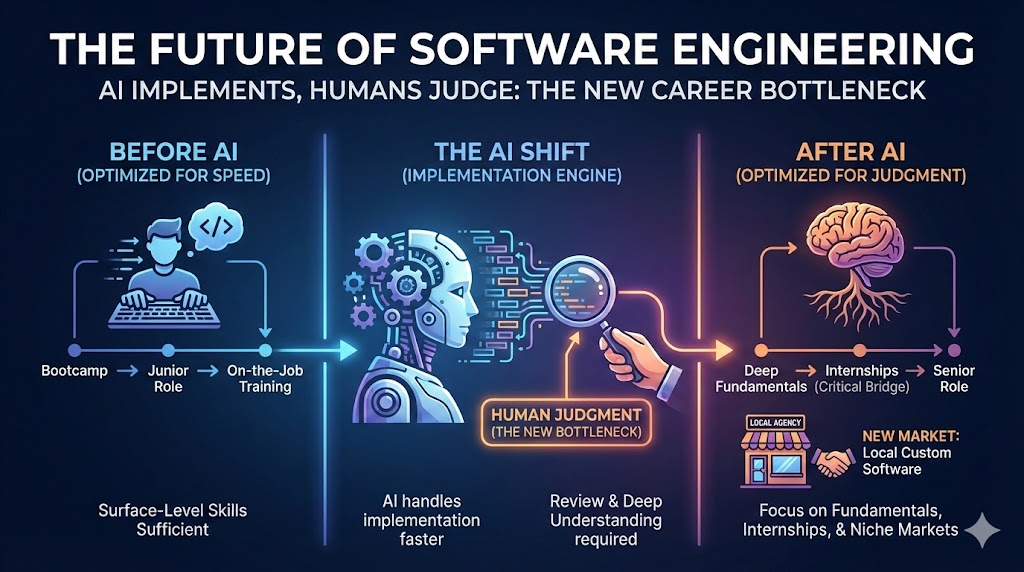
The Future of the Software Engineering Career: What Changes When AI Writes the Code
Table of Contents
A discussion has been circulating online about what happens to software engineering careers when AI can implement features faster than most junior developers. The conversation started from the idea that review is now the bottleneck in software development — humans verifying AI-generated output — and naturally led to a bigger question: what does this mean for someone starting their career today?
After reading through the arguments, the reasoning is surprisingly grounded. This post summarizes the key points, explains why each shift seems to matter, and adds some practical context.
Fundamentals Are No Longer Optional
For the past decade, the industry optimized for speed to employment. Learn a framework in twelve weeks. Build a portfolio. Get hired. Fill in the gaps on the job.
That model worked when companies needed people to write code. When the bottleneck was implementation speed, knowing just enough to be productive was a valid strategy.
That assumption is breaking down.
When AI handles the implementation, the value shifts to judgment — the ability to evaluate whether the output is correct, efficient, and appropriate for the context. And judgment requires deep understanding of how things actually work.
flowchart TD
  A[AI Generates Code] --> B{Engineer Reviews}
  B -->|Understands Fundamentals| C[Can Evaluate Correctness
Spot Edge Cases
Assess Trade-offs]
  B -->|Surface-Level Knowledge| D[Cannot Distinguish
Good Output from
Subtle Bugs]
  C --> E[Ship with Confidence]
  D --> F[Ship with Risk]
Consider concrete scenarios:
- Sorting algorithms — When AI produces a sorting implementation, can the reviewer tell if it is appropriate for the data characteristics? Stable vs. unstable, time complexity on nearly-sorted input, memory overhead
- Caching layers — When AI suggests a cache, does the reviewer understand the consistency trade-offs? Invalidation strategies, thundering herd, cold start behavior
- Distributed system design — When AI generates a system architecture, can the reviewer spot the failure modes? Split-brain scenarios, partial failures, consistency boundaries
Why this matters: Algorithms, distributed systems, hardware architectures, networking fundamentals, database internals — these were often treated as “nice to have” academic knowledge. They are becoming the practical foundation for evaluating AI-generated code. The engineer who deeply understands how things work will consistently outperform the one who only knows how to use them.
The Bootcamp Pipeline Is Narrowing
The bootcamp model was built on a specific assumption: companies would hire developers with minimal experience and invest in training them over time. Junior developer roles were abundant. The expectation was that you would learn the missing skills through years of professional practice.
That pipeline is narrowing — and the signal is already visible in hiring data and job boards.
flowchart LR
  subgraph Before["Before AI (Previous Model)"]
      A1[Bootcamp
12 weeks] --> B1[Junior Role
On-the-Job Training] --> C1[Mid-Level
2-3 years]
  end
  subgraph After["After AI (Current Reality)"]
      A2[Bootcamp
12 weeks] --> B2[Junior Roles
Shrinking]
      B2 -.->|Gap| C2[???]
  end
Why this is happening: A senior engineer with AI tools can now handle the work that used to be distributed across multiple junior developers — bug fixes, simple features, routine maintenance. The economics of hiring someone who needs extensive training become harder to justify when the alternative is amplifying existing senior talent.
Important nuance: This is not a statement that bootcamp graduates lack value. Many excellent engineers came through that path. The observation is that the on-ramp itself — the assumption that companies would provide years of training for entry-level hires — is shrinking. The path is not closed, but the bar for entry is rising.
Internships Become the Critical Bridge
If companies are hiring fewer juniors for training positions, how does someone develop the judgment that matters?
Internships — and they are becoming more important than ever.
An internship is effectively the new apprenticeship. It is the environment where someone learns what cannot be taught in a classroom:
- How to evaluate whether something is actually correct
- How to think about edge cases that do not appear in tutorials
- How to understand system behavior under stress
- How to make trade-offs with incomplete information
Why internships work for building judgment: Judgment comes from watching things break. From shipping something that appeared correct and discovering why it was not. From working alongside people who already have that judgment and internalizing their mental models.
Practical advice observed in the discussion:
- Optimize for internships at smaller companies where interns work closely with senior engineers — over large companies where interns are one of hundreds
- Prioritize learning judgment over resume prestige
- Look for programs where interns ship to production — that exposure to real-world complexity is what builds the instinct for evaluating code quality
Some large companies do offer exceptional internship programs where interns ship real features to production. But that is the exception, not the rule. Most large-company internships are structured experiences that do not fully expose interns to the complexity of production systems.
A New Industry Is Emerging: The Local Software Agency
This is perhaps the most interesting part of the discussion.
For decades, custom software was only economically viable for large organizations. Small businesses — restaurants, auto shops, accountants, tradespeople — used off-the-shelf products and worked around their limitations. Or used nothing at all.
AI-assisted engineering fundamentally changes this equation.
flowchart TD
  A[Small Business
Has Specific Need] --> B{Before AI}
  A --> C{After AI}
  B --> D[Too Expensive
Use Generic SaaS
or Nothing]
  C --> E[Local Developer
Builds Custom Solution
in Hours/Days]
  E --> F[Affordable
Tailored to Workflow
Maintainable]
A competent developer with AI tools can now build custom software in hours that previously required weeks or months. This opens an entirely new market:
- Restaurant needs a reservation system that matches their specific workflow — a local developer can build it
- Auto shop wants inventory management that works the way they actually operate — now affordable to customize
- Accounting office needs a client portal — no longer requires enterprise-level budgets
Why this comparison to early web development resonates: In the early days of the web, every business needed a website, and local web developers built them. The same pattern is emerging for custom software applications. Think of all the WordPress and Joomla customizations that small businesses relied on — now extend that to actual custom applications, workflows, and solutions to problems too niche for any SaaS product.
What this favors:
- Generalists who can move quickly across technologies over specialists in narrow stacks
- Communication skills — understanding client problems and translating them into working solutions
- Judgment over raw coding speed — knowing what to build and whether it works correctly
Career Decision Matrix
Based on the discussion, here is a summary of how the landscape is shifting across different career stages:
flowchart TD
  A[Where Are You?] --> B[Student]
  A --> C[Career Changer]
  A --> D[Working Developer]
  B --> B1[Invest deeply in
CS fundamentals]
  B --> B2[Pursue internships
aggressively]
  B --> B3[Build judgment
not just skills]
  C --> C1[Understand the bar
is rising]
  C --> C2[Build a realistic plan
not depending on
junior roles]
  C --> C3[Focus on fundamentals
+ practical experience]
  D --> D1[Enormous opportunity
in custom software]
  D --> D2[Position for markets
that could not
afford software before]
  D --> D3[Leverage AI tools
to multiply output]
Takeaway
The core argument is straightforward: the human in the loop is not going away. As AI tools become more powerful, the human actually becomes more important — but the nature of the work shifts from writing code to evaluating it.
What changes is which humans, doing what work, for whom.
- The engineer who understands fundamentals deeply can evaluate AI output with confidence
- The developer who can communicate with non-technical clients and deliver tailored solutions unlocks an entirely new market
- The student who builds judgment through real-world internships enters the workforce with the skill that matters most
The future belongs to those who can judge whether something is correct — not just whether it compiles.
This post summarizes and restructures a widely discussed article on the future of software engineering careers in the age of AI. The original discussion explores how AI implementation speed shifts value toward human judgment, and what that means for education, hiring, and new market opportunities. The landscape is evolving rapidly — these observations reflect the current moment.