
The Shift from Code to Orchestration: Building an AI-Native Engineering Culture
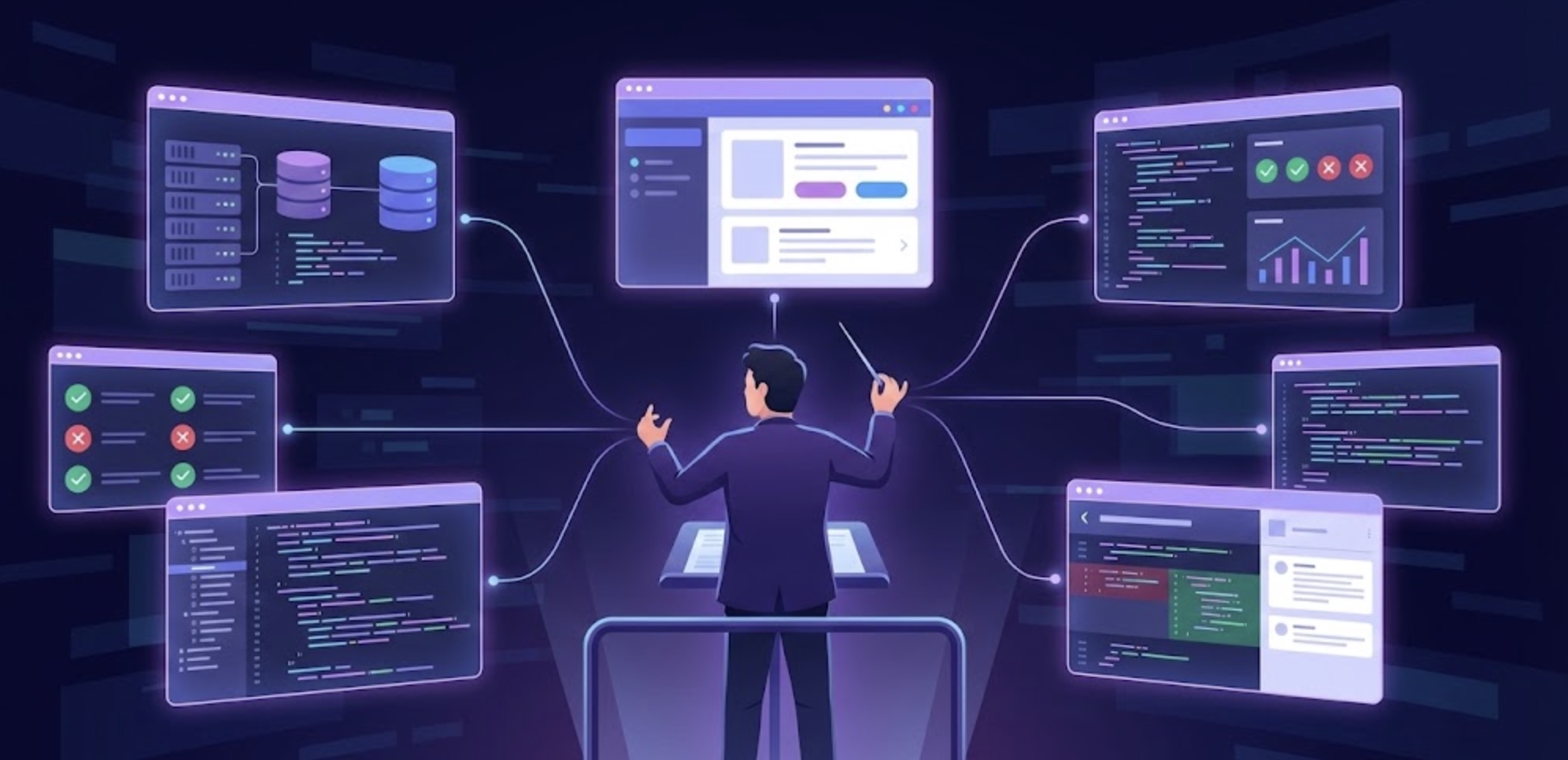
I have been thinking a lot about how the role of a software engineer is shifting. Not in the abstract “AI will replace us” way that gets clicks, but in the concrete, day-to-day operational sense. The way we design systems, manage workflows, and build engineering teams is going through a structural transition — from writing raw syntax to orchestrating autonomous intelligence.
What follows is my breakdown of the core mechanics driving this change. I am not claiming to have all the answers. But after observing how my own workflow has evolved, reading industry reports, and watching how top engineering organizations are adapting, some patterns feel clear enough to share.
The Rise of the AI-Native Engineer
The emergence of the AI-native engineer marks a new operational standard. This is the first generation of developers who treat AI as the primary language of development — not an add-on, not a nice-to-have, but the default way of working.
What does this actually look like? The role of a single engineer is expanding. You are no longer just someone who writes code. You are becoming a manager of specialized agents — each one handling a focused domain, each one requiring clear instructions and verification, much like managing a team of engineers.
flowchart TD
    E["AI-Native Engineer"] --> A1["Agent: Backend Logic"]
    E --> A2["Agent: Frontend UI"]
    E --> A3["Agent: Test Generation"]
    E --> A4["Agent: Code Review"]
    A1 --> V1["Verify Output"]
    A2 --> V2["Verify Output"]
    A3 --> V3["Verify Output"]
    A4 --> V4["Verify Output"]
    V1 --> I["Integrate & Ship"]
    V2 --> I
    V3 --> I
    V4 --> I
This is not science fiction. Anthropic reported that 70–90% of their code is now AI-generated, with teams across data infrastructure, security, inference logic, and even growth marketing using Claude Code as a daily tool. Non-engineers at Anthropic are writing plain text descriptions of data workflows and getting fully automated execution.
If that is where the frontier organizations are today, the rest of the industry is not far behind.
Part 1 — What Is Happening to Junior Software Engineers?
This is the part that I find both concerning and fascinating. We are navigating what I would call a “perfect storm” in the tech talent market. Three macroeconomic factors have collided:
- Market Corrections: Post-2021 overhiring led to significant layoffs, creating a surplus of experienced talent competing for the same roles.
- Surge in CS Graduates: The volume of computer science graduates has doubled or tripled over the last decade, both nationally and internationally.
- AI Integration: Engineering leadership is actively calculating whether to backfill traditional headcount or leverage fewer, AI-native engineers to meet output quotas.
The numbers tell the story. Entry-level hiring at the 15 biggest tech firms fell 25% from 2023 to 2024, and employment for software developers aged 22–25 has declined nearly 20% from its peak in late 2022. 54% of engineering leaders plan to hire fewer juniors, thanks to AI copilots enabling seniors to handle more.
This environment makes entry-level hiring brutally competitive. Junior engineers who want to enter the field now need to master both traditional fundamentals and AI orchestration — not one or the other.
My honest take: I do not think this means junior roles disappear entirely. But the bar has moved. The juniors who thrive will be the ones who can demonstrate they are productive with AI tools from day one, not the ones who need 3–6 months of ramp-up to start contributing.
Part 2 — How Top AI-Native Engineers Orchestrate Agents
Here is where it gets practical. The elite AI-native engineer does not abandon traditional computer science. They rely on strong system design and algorithmic thinking to guide agentic workflows. Throwing multiple agents at a problem does not create a better system — unmanaged, it creates chaos.
GitHub’s engineering blog puts it well: multi-agent workflows often fail because agents exchange messy language, share implicit state, or make ordering assumptions that break silently.
Here are the patterns I have seen work consistently:
Build It Up Piecemeal
Scaling multi-agent systems requires strict isolation. Do not initialize ten agents simultaneously. The correct approach is iterative:
- Assign one agent to a highly isolated task and verify its output thoroughly.
- Once confident, introduce a second agent for a completely separate domain (e.g., one handles backend logic, another updates the frontend UI).
- Define the boundaries of work clearly before adding complexity.
Example: Say you are building a new API endpoint with tests. Instead of spinning up agents for “backend + frontend + tests + docs” all at once, start with one agent writing the endpoint handler. Verify it compiles and makes sense. Then spin up a second agent to write tests against that verified handler. Each agent works against a known-good baseline.
Context Switching as a Core Skill
Managing agents mirrors human engineering management. You are essentially kicking off parallel threads of work across highly eager “interns.” The defining skill of a top-tier orchestrator is the ability to maintain state — switching context between Agent A’s task and Agent B’s task without losing the overarching architectural vision.
This is harder than it sounds. I have personally caught myself reviewing Agent B’s output while forgetting a key constraint I set for Agent A. The discipline required is similar to being a tech lead managing multiple workstreams simultaneously.
Agent-Friendly Codebase
If an agent is released into your repository, it needs a deterministic environment to operate safely.
- Strict Contracts: Test coverage is the absolute contract for correctness. Without robust tests, agents operate blindly and will break the build.
- Documentation Parity: Code and documentation (like READMEs,
CLAUDE.mdfiles) must be perfectly synchronized. If the code says one thing and the docs say another, the agent will stall or hallucinate a resolution.
Example: Imagine an agent that needs to add a new field to a data model. If your README says “all models use snake_case” but half your codebase uses camelCase, the agent has to guess. It will pick one — and it might pick the wrong one. Engineering consistency is not just good practice anymore; it is a prerequisite for automated scaling.
When You Get Spaghetti Code
Agents compound errors rapidly. If an agent misinterprets poorly structured code in step one, it will double down on that error in step two, magnifying the technical debt exponentially.
flowchart LR
    A["Inconsistent
Codebase"] --> B["Agent Misinterprets
Pattern"]
    B --> C["Builds on Wrong
Assumption"]
    C --> D["Compounds Error
in Next Step"]
    D --> E["Technical Debt
Multiplied"]
    style A fill:#ff6b6b,color:#fff
    style E fill:#ff6b6b,color:#fff
To prevent this, the initial state of the codebase must be airtight. Consistent design patterns are mandatory. If your system has two different APIs to instantiate the same object, the agent will guess which to use. Strict linting, clear architectural rules, and a well-maintained CLAUDE.md or equivalent are prerequisites — not nice-to-haves.
Part 3 — Functional Software vs. Incredible Software
Here is something that AI tools will not tell you: the delta between functional code and exceptional software is engineering “taste.”
Taste is developed in the “last mile” of development — pushing past baseline requirements to solve complex edge cases and expand system robustness. An AI agent can generate a working CRUD endpoint in seconds. But deciding how that endpoint should handle rate limiting under traffic spikes, what the degradation strategy should be, and whether the error responses help or confuse downstream consumers — that is taste. That comes from experience and from caring enough to push past “it works.”
Furthermore, continuous experimentation is non-negotiable. Even top AI organizations practice this aggressively. Anthropic routinely dogfoods their own models — using Claude to rewrite their own systems, discovering what works and what breaks in real production scenarios. Hacking, rapid iteration, and dogfooding must be deeply embedded into your SDLC.
My honest take: If your team is not using AI tools to build the systems that manage AI tools, you are leaving compounding improvements on the table. The feedback loop of “use the tool → find the gap → improve the tool → repeat” is where real engineering taste gets sharpened in the AI era.
Part 4 — Why the World Still Needs Junior Software Engineers
After everything above, you might think I am building the case against junior hiring. The opposite is true. It is a strategic mistake to discount junior talent in the AI era.
Here is why:
Senior engineers carry bias. They are accustomed to specific paradigms — specific frameworks, specific ways of debugging, specific mental models of how systems “should” work. This experience is invaluable, but it also makes them resistant to fundamentally new workflows. I have seen senior engineers refuse to use AI coding tools because “it is faster to just write it myself” — missing the point that the skill is not typing speed, it is orchestration leverage.
Junior engineers are blank slates. They lack the “industry scars” that make veterans risk-averse. Because their foundational CS training teaches them to break down systems algorithmically, they possess the raw adaptability to debug, customize, and fix AI-generated code rather than abandoning the tool at the first sign of failure.
Stack Overflow’s analysis on AI vs Gen Z developers makes a compelling point: today’s AI-native juniors often arrive already fluent in tools like Copilot or ChatGPT. Instead of spending weeks learning syntax, they can start contributing almost immediately — if the organization gives them the right environment.
Example: A junior engineer who has never built a REST API before but knows how to prompt an agent to scaffold one, then manually reviews the output against design patterns they learned in school — that engineer is potentially more productive on day one than a junior from five years ago who needed to memorize framework boilerplate before writing a single endpoint.
Their willingness to boldly tackle complex problems makes them highly potent assets in an AI-driven organization. The key is giving them strong architectural guardrails and code review processes, not sheltering them from complexity.
Why I Started TP Coder Innovation Hub
This is actually one of the biggest reasons I created the TP Coder Innovation Hub — a non-profit digital ecosystem dedicated to empowering Thai tech talent.
I saw this trend coming last year. The signs were everywhere: junior hiring slowing down, AI tools accelerating, and a growing gap between what the industry expects and what new graduates are equipped to do. I kept thinking — if the industry is shifting this fast, someone needs to help the next generation bridge that gap. And after mentoring through Generation Thailand’s JSD program for over 7 cohorts now, I had seen firsthand how many talented people get stuck in the “experience trap” — they cannot get hired because they lack experience, but they cannot get experience because no one will hire them.
AI makes this trap worse and better at the same time. Worse because companies now expect even juniors to be productive from day one. Better because with the right guidance, AI tools can compress the learning curve dramatically — a mentee who learns to orchestrate agents effectively can build a job-ready portfolio in weeks instead of months.
That is exactly what the Hub focuses on: structured learning paths, GitHub-based projects with professional code reviews, and mentorship to build portfolios that demonstrate real capability — not just tutorial completions. We specifically focus on creating equal opportunities for Thai developers regardless of location, physical ability, or economic background. There are talented people outside Bangkok, people with disabilities who could thrive in remote work, and career switchers who just need the right environment to make the leap.
The shift from code to orchestration is not just a technical trend to observe. For me, it is a call to action — to make sure the next generation of Thai developers is not left behind, but instead becomes the most AI-native, most adaptable engineering workforce in the region.
Wrapping Up
The shift from code to orchestration is not a future prediction — it is happening now. The engineers who thrive will be the ones who:
- Treat AI agents as team members, not magic black boxes
- Invest in codebase health as a prerequisite for automation, not an afterthought
- Develop engineering taste through experimentation and dogfooding
- Embrace junior talent as the most adaptable workforce for the AI-native era
The role of the software engineer is not shrinking. It is expanding — from someone who writes code to someone who architects systems, manages agents, and makes the judgment calls that no model can automate.
That, to me, is a more interesting job than the one we had before.
Read More
If you want to dive deeper into specific topics covered in this article, here are some related posts:
- What is Agent Skills about? — A deep dive into how modular skills give AI agents focused capabilities instead of monolithic prompts. Directly relevant to the “agent-friendly codebase” concept in Part 2.
- Sharing Guidelines for AI Coding Agents: What Actually Works in Real Codebases — Practical guidelines for structuring how agents plan, execute, and verify work. The operational playbook behind the orchestration principles discussed here.
- From Monolithic Agents to Composable Workflows — How microservices architecture patterns apply to building reliable multi-agent systems. Expands on the “build it up piecemeal” approach from Part 2.
- Top 10 Types of AI Agents — A comprehensive overview of agent architectures from reactive to multi-agent systems. Useful context for understanding the types of agents you would be orchestrating.